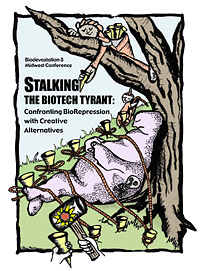
STALKING
THE BIOTECH TYRANT:
Confronting
Biorepression with Creative Alternatives
Saturday,
May 15, 2004 • 9:15
am to 5:30 pm
Click for Schedule • Workshop Sessions • Descriptions
| $15
($10 low income) Advance Registration $20 at the door /$10 half day |
Lunch is not
included. Advance registration must be postmarked by May 8. Make checks
to 'GGA'; Send Registration Form with check to: Gateway Green Alliance, PO Box 8094, St. Louis MO 63156 Registration Form - PDF Registration Form - HTML |
|
|
Location
|
||
9:45 am
10:00 - 11:00 am
11:15 - 12:45 pm
12:45 - 2:15 pm
2:15 - 2:45 pm
2:45 - 4:15 pm
4:30 - 5:30 pm
Puppet Show by digger (possible Schmeiser call)
Keynote by Dr. Marti Crouch

Session 1 Workshops
Lunch
Africa Voice drummers
Session 2 Workshops
Wrap-up plenary...what did we learn, what needs to be done?
Genetic Modification & Engineered Humans
Beyond Terminator Technology
GMOs & Western Domination of the Third World
Food for People AND Profit?
ABCs of Biotechnology for Students from 10 to 80
Patents & International Property Rights: Commodification of Life
What Biologists Don't Know: Exploring the Fraudulent Science of Biotech
A Truth Mandala on Biotech Tyranny
Ethical Issues of Bioengineered Food
Exposing & Explaining the WAF
(World Agricultural Forum)
Saving the Plains, Saving the Planet: Hemp Based Industry for the US
Are Your Food Choices Helping or Harming the Earth?

Beyond Terminator Technology
Martha Crouch, PhD. , Professor of Biology, Indiana State University
In the late 1990s several patents designed to keep farmers fromsaving genetically engineered seeds were made public by activists. TheseTerminator Technologies were supposed to build patentprotection into seeds using a complex cascade of toxins, and worked bykilling the entire generation of seeds harvested from anengineered crop. There was an international outcry against thisdramatic break in the cycle of seed-saving. Many biotech companies vowed to discontinue work on these technologies as a concession to publicopinion.
Now the Terminator is back and dressed in green! With the mounting evidence of widespread contamination of traditional seeds stocks by genetically engineered traits, and worries about spread into wild populations, various schemes for limiting this spread have beenproposed. Many of the ideas bear an uncanny resemblance to theoriginal Terminator Technologies in that they limit contamination by killing the plants that receive the genetically engineered trait.
I will review the original Terminator, compare it to the latestplans, and discuss whether using sterilization techniques is asensible solution to the problem of contamination from genetically engineered crops.Genetic Modification and Engineered Humans
David Kennell, PhD., Prof. of Molecular Microbiology, Washington University
Interaction of science and society presents enormously complex issues regarding applications of GM to humans as we enter "Biotech Century." Insertions are at random sites. Somatic vs. Germ-line genetic modification will be discussed. Beneficial uses of GM: lab production of biomedical molecules, potential somatic cell intervention, DNA testing/"DNA chips." The profit motive is the overiding force for danger, e.g., human growth hormone. Germ-line changes are permanent. Who decides? At what do we stop? Genetic discrimination is already a legal issue: insurance, health care, education, employment. (Most diseases have variable outcome as a function of many variables, especially environment. Also, evolution has selected some "errors" that are beneficial in specific environments, e.g., sickle cell trait in Africans as a protection against malaria.)
If humans cannot solve problems of society, will humans have to be re-programmed to adapt to society? Are social behaviors (criminality) and physical traits (obesity, shortness, skin color) to be defined as "errors" or defects in genome? Are humans machines to engineer to eliminate defined genetic "errors"? Projected are two classes of humans in the future: "GenRich" (perhaps 10% of population) and "Naturals" who perform menial tasks. The new Eugenics includes dreams of a "super-race," or even a new species, genetically designed for affluence (not really new goal or new motive--just a new technology to achieve it).GMOs and Western Domination of the Third World
Zaki Baruti, head of the Universal African People Organization, Co-Coordinator, Green Party of St. Louis
Don Fitz, spokesperson on Toxins, Green Party of St. Louis
For centuries western countries have subjugated and plundered peoples of Africa, Asia and Latin America. The independence granted former colonies changed the face of exploitation but not its essential nature. The recent introduction of genetically modified crops in the third world is a new biological imperialism that threatens to poison agricultural workers, undermine public health, drive small farmers off the land and allow a massive transfer of wealth to western corporations. This workshop will emphasize developments in Africa.Food for People AND for Profit?
Eric Hempel, MO organic farmer
Today, the food on most North Americans' tables comes from thousands of miles away and just a handful of corporate giants. This market control, along with new technologies designed to profit big firms, increases risks to food security and safety. Without the economies of scale enjoyed by those few agribusiness firms, family farmers producing food for people find the farm lifestyle difficult to make economically feasible.
Organic, sustainable, local food production has never disappeared from the food landscape and is resurging in popularity. Shortening the distance between the producer and the consumer of food addresses the economic, political and social challenges facing small to medium scale producers. Topics of food, farming and rural life will be discussed.The ABCs of Biotechnology for students from 10 to 80
Suzanne Renard
This workshop will explain the basics of genetic engineering and how it can contaminate food, damage helpful species (such as butterflies) and hurt farmers in Africa, Asia and the Americas.Patents and International Property Rights: The Commodification of Life
digger
This workshop will explore the patenting of plants and animals, the corruption of university research for patent give-aways to corporation and how bioprospecting is theft of indigenous peoples. We will discuss Global Free Trade Treaties such as NAFTA and FTAA, and how international property rights is destroying the world agricultural system, is an assault on the rights of family and peasant farms and will consolidate corporate control over every aspect of our life. Plus, get the latest on the Percy Schmeiser vs. Monsanto case.What Biologists Don't Know: Exploring the Fraudulent Science of Biotech
Andy Hilgartner
Sometimes, biologists seem so DUMB about things biological. Don't they understand the biosphere, in principle? Can't they see that GMO's violate the survival-principle of Earth's organisms? Well, no, they can't. But, I believe, I can, do. Come learn about it -- see for yourself.A Truth Mandala on Biotech Tyranny: an Experiential Workshop
Chris McClarren, facilitator
The beautiful tapestry of life as we know it took millions of years to create itself. Out of it we were born. To risk this multiplicity is to risk unstringing the world, said author Michael Pollan as he referred to the risk the Biotech Tyrants of our time are taking as they declare war on this weave of wildness. As they exploit and profit off very serious problems (such as war, hunger, injustice, and ecocide) with their pretend fixes and "controls," they shrink the future open to all of us. They shrink the door through which non-oppressive creative alternatives can viably be given opportunity.
I invite you to share with other caring folk the truth in your heart about this by participating in a Truth Circle. Many of us are experiencing a range of feelings we are keeping hidden: anger, grief, fear, emptiness, confusion, etc. The Truth Circle is a facilitated group exercise that provides a simple, respectful group structure for owning and honoring these feelings. Unexpressed, these feelings can lead to ineffectiveness in our work for change, burn-out, and an inability to feel the joy of life. After a Truth Circle, participants often come away further empowered to continue to creatively and sustainably respond.Ethical Issues of Bioengineered Food
Gabriel Mary Hoare, S.L
An opportunity for those who have been following the saga of Genetic Engineering, Genetically Modified Organisms or more specifically, Bioengineered Food and would like to join the creative power of a knowledgeable and concerned community to help find answers to the ethical and moral questions posed by the proliferation of biotechnology, the future of biosafety and biodiversity.Exposing and Explaining the World Agricultural Forum (WAF)
Sarah Bantz, MoRAGE
Is the World Agricultural Forum yet another Monsanto front group? Is it a bastillion of conservative free-traders masked as do-gooders? A slick public relations move to play US progressives against foreign activists? How does the WAF fit into the alphabet soup of globalization? How has it evolved, and where will it strike next? For answers and more, come to this workshop.
Sarah Bantz is a farmer, economist, activist, writer, and bartender from mid-Missouri. She is currently researching how white supremacy undergirds the Lewis and Clark Bicentennial celebrations.Saving the Plains, Saving the Planet: Hemp Based Industry for the US.
Terri Zeman and Fred Raines, NORML
Although America's leading agricultural crop for much of its history, (non-psychoactive) hemp agriculture has been banned in the US since 1937, the deceitful legacy of Dupont and Hearst whose economic interests in synthetic fibers and timber were threatened. With new and rapidly expanding uses for its seeds, fiber and stalk, its environmental friendliness, and its ability to spawn local industry, hemp is the ideal crop for a moribund rural Great Plains economy. We focus on hemp bio diesel, a locally produced alternative to petrol diesel that reduces emission pollutants by 75% and helps stabilize global warming.Are Your Food Choices Helping or Harming the Earth?
Angie Spencer and Mary Chipman, St. Louis Vegetarian Society
What we choose to eat has more of an effect on the environment than most people realize. Examine the effects of factory farming on the environment.
• Water and Air pollution
• Land water and fossil fuel consumption for animal feed
• Overgrazing and soil degradation
• Rainforest devastation and habitat destruction
• Widespread Chemical use
There is a better way--plant-based diets. This will be an interactive workshop!
